


The flag, the coat of arms, the Cross of Burgundy, the yoke and the arrows are not mere decorations. They are visible signs of a history that still speaks to millions of Spaniards. To speak of the legacy of the Catholic Monarchs in current Spanish symbolism is to speak of a decisive era: the dynastic union of Castile and Aragon, the culmination of the Reconquista, the Atlantic expansion, and the affirmation of a Hispanic political consciousness that left its mark for centuries.
Not all the symbols we associate with Spain today were born exactly under Isabella of Castile and Ferdinand of Aragon. It is worth stating this with rigor, because knowing history does not weaken pride: it strengthens it. But there is indeed a clear thread between their reign and much of the national imagination that has reached our days.
The legacy of the Catholic Monarchs in Spanish symbolism
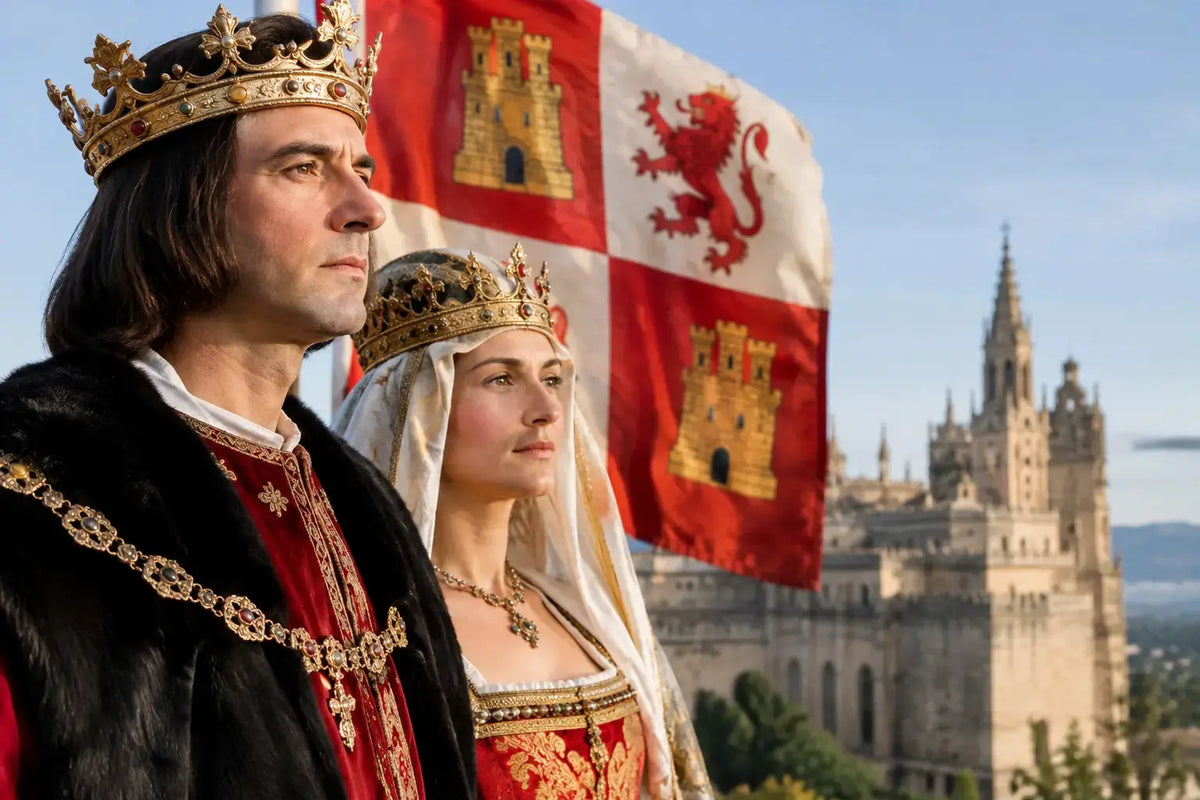
The Catholic Monarchs did not create a modern nation-state in the current sense of the term. Castile and Aragon retained their own institutions, laws, and structures. However, their marriage in 1469 and their joint rule represented a union of enormous political, religious, and symbolic significance.
Under their crown coincided events that continue to form part of the Spanish memory: the conquest of Granada in 1492, the end of Muslim rule on the peninsula, Columbus's voyage, the opening of new routes, and the incorporation of Navarre into the orbit of the Hispanic Monarchy. This accumulation of events turned their reign into a permanent reference of unity, faith, enterprise, and historical will.
Their symbolic heritage should not be understood as a museum piece. It continues to appear in institutional acts, commemorations, historical reenactments, flags, clothing, accessories, and decorative objects. For many Spaniards, these emblems express belonging, respect for their ancestors, and gratitude for a history that did not begin yesterday.
The yoke and the arrows: two personal emblems turned into memory
The yoke and the bundle of arrows are probably the most recognizable signs linked to the Catholic Monarchs. They were not state emblems in the way we understand a national coat of arms today, but rather the personal emblems of the monarchs.
Ferdinand chose the yoke, traditionally associated with Isabella's initial. The arrows were Isabella's emblem and were related to Ferdinand's initial. The choice contained a very calculated political message: two different sovereigns who ruled together, each with their own identity, but oriented toward a common purpose.
The motto "Tanto monta" is also associated with Ferdinand the Catholic. It is often interpreted as a declaration of absolute equality between the two monarchs, although its historical origin is related to the episode of the Gordian knot and the idea that what matters is to complete the task, not the exact way of doing it. Over time, the expression became incorporated into the imagination of the Catholic Monarchs and their joint reign.
These emblems conveyed a very powerful idea for their time and ours: unity does not require erasing what is one's own. There can be local roots, regional affections, and diverse traditions within a higher loyalty to Spain. The yoke and the arrows evoke precisely that will to walk in the same direction when the homeland calls for it.
A symbol with later interpretations
History requires recognizing that the yoke and the arrows were reused by 20th-century political movements, especially by the Falange and the Franco regime. This later appropriation conditions the current perception of the emblem and means that not everyone interprets it in the same way.
But a later political use does not alter its 15th-century origin nor exhaust all its meaning. Separating the eras allows for a better understanding of the symbol. Whoever contemplates it from the history of the Catholic Monarchs can see a royal emblem, an image of unity, and a reference to one of the founding moments of historical Spain. Whoever uses or displays it must do so with knowledge and respect for that complete context.
The coat of arms of Spain and the heritage of the kingdoms
The current coat of arms of Spain is not the exact coat of arms of the Catholic Monarchs, but it preserves the memory of the great kingdoms that formed the Hispanic Monarchy. The castle of Castile, the lion of León, the bars of Aragon, the chains of Navarre, and the pomegranate of the former Nasrid kingdom summarize centuries of peninsular history.
The pomegranate has a value especially linked to the Catholic Monarchs. Its incorporation into the royal arms after the conquest of 1492 left a heraldic record of the culmination of the Reconquista. It was not an ornamental detail: it proclaimed that Granada had become part of the Crown and the political community that was being consolidated.
The current coat of arms also incorporates the Pillars of Hercules and the motto "Plus Ultra," elements developed especially during the reign of Charles I. Even so, it would be impossible to understand that later imperial and oceanic vocation without the momentum started with the discovery of America under Isabella and Ferdinand.
That is why, when a flag of Spain displays the coat of arms, it does not show only an administrative organization. It brings together a genealogy of kingdoms, campaigns, laws, languages, saints, navigators, soldiers, and families. It is a synthesis of Spanish historical continuity, with all its complexities and all its greatness.
The Cross of Burgundy: historical precision and Hispanic pride
The Cross of Burgundy is frequently associated with the Catholic Monarchs, although its widespread presence on the flags of the Hispanic Monarchy came later. It comes from the Burgundian heritage linked to Philip the Handsome and spread especially from the reigns of Charles I and Philip II.
It is, therefore, not an emblem created by Isabella and Ferdinand. However, it belongs to the historical universe born from the monarchy they founded. The dynastic union, the expansion of the Crown's territories, and the European marriage alliances made it possible for the Hispanic Monarchy to adopt symbols that would eventually fly in fortresses, ships, and battlefields across half the world.
Its red spokes recall the split logs on which Saint Andrew was martyred. For centuries, the Cross of Burgundy identified armies, naval units, and territories of the Spanish Crown. Today it continues to awaken a sense of continuity among those who honor the military tradition, Hispanidad, and the defense of Spain.
Wearing it on a t-shirt, a bracelet, a flag, or a home accessory does not mean living anchored in the past. It can be a conscious way of declaring that national history deserves to be known, defended, and passed down. That is the value of a living symbol: it does not force the repetition of the past, but prevents it from being forgotten.
From history to everyday symbols
National emblems have strength when they leave the book and accompany real life. A flag on a balcony during a significant date, a pin on a jacket, a bracelet with the red and gold, or a historical detail in the home can express affection for Spain without the need for grand speeches.
They are also a form of conversation between generations. A grandfather explaining what the arms of Castile and León represent, a mother teaching her children why the pomegranate is on the coat of arms, or a young person asking about the Cross of Burgundy are making their homeland in the deepest sense: transmitting memory.
In this area, fashion and everyday objects have a legitimate role. La Flamenca de Borgoña turns landmarks such as the flag of Spain, the Cross of Burgundy, and other national emblems into visible pieces for those who do not want to hide their love for their homeland. The key is to wear them with dignity, knowing what they tell and avoiding reducing them to a simple aesthetic.
A heritage that calls for knowledge and loyalty
Current Spanish symbolism does not belong to a single era or a single sensibility. It is composed of layers: the medieval kingdoms, the Christian faith, the Reconquista, the American enterprise, the military tradition, contemporary institutions, and the experience of millions of Spaniards.
The Catholic Monarchs occupy a central place in that narrative because they represent a will to unity that transformed the history of Spain. Their legacy does not consist in idealizing without nuance, but in recognizing that there were generations capable of thinking big, defending a common cause, and leaving their descendants a homeland with memory.
Whoever chooses to display these symbols can do so with pride and also with responsibility. Knowing their origin, explaining their meaning, and passing it on to the youngest is a concrete way to honor Spain: not as an abstract idea, but as a received heritage that deserves loyalty, care, and a future.


