


The expression origin of the Cross of Santiago: a guide to identifying it on products answers a frequent question among those who proudly wear symbols of our history. It is not enough to see a red cross to know what it represents: the Cross of Santiago has its own shape, legacy, and visual power. Recognizing it allows you to choose a garment, a piece of jewelry, or a home accessory with knowledge, respect, and a true sense of belonging.
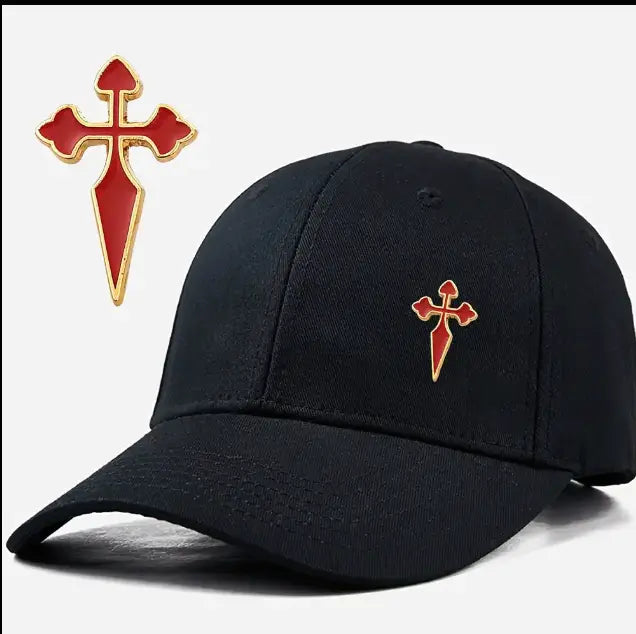
Pin with the Cross of Santiago: https://laflamencadeborgona.es/products/pin-cruz-de-santiago?utm_source=copyToPasteBoard&utm_medium=product-links&utm_content=web
Origin of the Cross of Santiago and its meaning
The Cross of Santiago is linked to the Order of Santiago, one of the great Hispanic military orders of the Middle Ages. It emerged in the Kingdom of León around 1170, at a time when the defense of Christian territories, the protection of the roads, and aid to pilgrims were matters of the highest importance. It received papal approval in 1175 and came under the patronage of the apostle Santiago, patron of Spain.
Its emblem was not conceived as a simple ornament. The cross takes the shape of a sword, an image that united faith, service, and combat. Its upper arms end in fleurs-de-lis, while the lower part is elongated and sharpened like a blade. The intense red, traditionally associated with shed blood and sacrifice, reinforces its warrior and spiritual character.
The apostle Santiago holds a central place in Spanish memory. The Jacobean tradition, the pilgrimages to Compostela, and the figure of Santiago as the protector of Christians on the Iberian Peninsula made this cross a recognizable sign of devotion and identity. Wearing it today does not require literally reproducing the life of a medieval knight, but it does connect with a legacy of honor, loyalty, and defense of one's own.
How to recognize the authentic silhouette of the Cross of Santiago
The key to identifying it lies in looking at the complete structure, not just the color. On fashion and home decor products, it may appear embroidered, printed, engraved, or turned into a metal piece. The material changes, but its essential features must be maintained.
The Cross of Santiago is usually red and vertical. Its lower arm is clearly longer than the others and ends in a point, like a sword thrust downward. The three upper arms—the vertical one and the two side ones—end in a stylized floral shape, similar to a fleur-de-lis. That combination of sword and flower is what distinguishes it from many other historical crosses.
Proportion also matters. In a well-executed representation, the vertical axis dominates the composition, and the lower point is visible even when the design is small. If the symbol looks like a symmetrical cross with four equal arms, it is probably not the Cross of Santiago, or it is such a simplified version that it has lost its visual identity.
The details to check on a product
When you have a t-shirt, bracelet, pendant, flag, or home item in front of you, check these four elements:
- The traditional color is red, although the background may be white, black, navy blue, green, or other shades.
- The lower arm must be elongated in the shape of a sword and end in a point.
- The ends of the upper arms should resemble a fleur-de-lis, not circles or straight ends.
- The cross must maintain a clear vertical orientation, with the presence of the emblem and not as just any geometric figure.
Not all red crosses are the Cross of Santiago
Spain preserves an extraordinary heritage of military orders and religious symbols. That is why it is easy to confuse emblems that share an era, color, or inspiration. The difference is not a minor detail: each cross tells a different story.
The Cross of Calatrava is also red and has floral ends, but its overall shape is more balanced and does not feature the long, pointed sword characteristic of Santiago. Its four arms are distributed more symmetrically. If you notice that the lower part is not obviously elongated, you should think of Calatrava before Santiago.
The Cross of Alcántara is very similar in structure to that of Calatrava, although it is traditionally represented in green. For its part, the Cross of Montesa usually appears in black and has a different configuration. Color helps, but it should not be the only criterion: there are artistic recreations and modern products that modify shades for aesthetic reasons.
The Cross of Santiago should also not be confused with the Cross of Burgundy. The latter is formed by two knotted trunks crossed in an X shape and belongs to another historical language, linked to the Hispanic Monarchy and its armies. Both inspire pride among those who love the history of Spain, but they are different and non-interchangeable symbols.
Where this historical emblem looks best
The versatility of the Cross of Santiago explains why it is still present centuries after its birth. On a t-shirt or polo shirt, it can occupy the chest discreetly or become the center of a bolder design. On sweatshirts and outerwear, it works especially well in large formats, where its sword silhouette is recognizable from a distance.
In jewelry and accessories, size demands precision. A small pendant must retain the lower point and the upper ends, because they are the details that prevent it from looking like a generic cross. On bracelets, keychains, or cufflinks, a sharp engraving is worth more than an overloaded reproduction where the outline is lost.
For a pilgrimage, a religious celebration, a family gathering, or a meaningful gift, the cross provides a message that goes beyond aesthetics. It speaks of Spanish tradition and a connection with Saint James the Apostle. It also fits in home decor: cushions, prints, textiles, or desk accessories can incorporate the emblem without the need to turn the entire space into a museum.
The context determines the appropriate design. Someone looking for an everyday garment may prefer a small embroidered cross; someone who wants to express a conviction clearly can choose a more visible print alongside other national symbols. There is no single way to wear Spain, but there are symbols that deserve to be recognized and treated with fidelity.
A practical guide to choosing with discernment
Before choosing a product with this emblem, think about what you want to convey. If the intention is religious, look for a clean and respectful representation, where the cross takes center stage. If you are looking for a garment of historical or patriotic identity, it can be combined with references to Spain, the Camino de Santiago, or the military tradition of the orders.
Also observe how the symbol has been applied. Embroidery offers relief and presence; printing allows for broader compositions; metal provides a sober finish for accessories and gifts. No technique is superior in all cases: it depends on the use, the size, and the visual intensity you want to achieve.
In a wide catalog of fashion, accessories, and home products, such as that of La Flamenca de Borgoña, knowing how to identify the Cross of Santiago helps you find pieces with a concrete message. It is not just about choosing a beautiful motif, but about recognizing the emblem that best represents a history, a faith, or a way of living Spanish pride.
The next time you see a red cross on a garment or a gift, pause for a moment to look at its silhouette. If you see a vertical sword topped with fleurs-de-lis, you are not looking at just any design: you are contemplating a symbol that has accompanied Spain for centuries and that can still be worn with respect, memory, and your head held high.


