


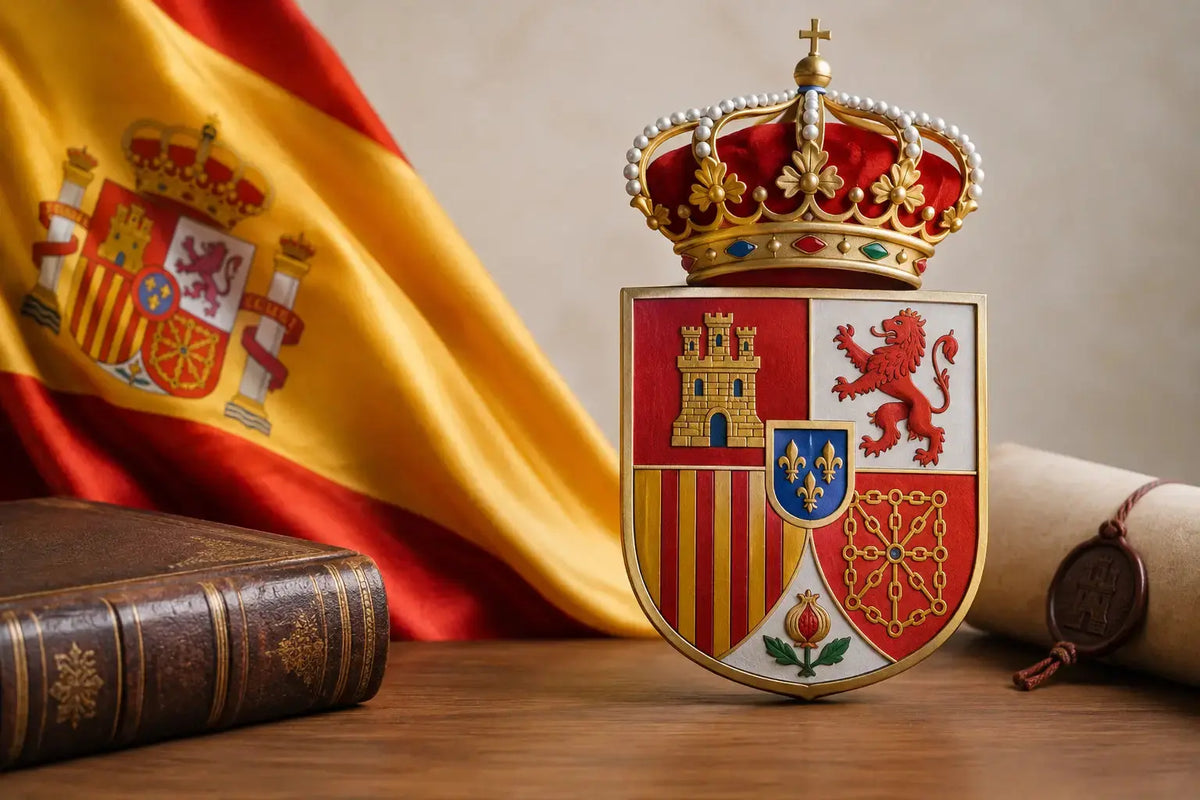
A golden castle on a red field, a rampant lion, the chains of Navarre, or the open pomegranate: the best examples of Spanish heraldry are not mere decorations. Each figure concentrates a memory, a territory, and a way of understanding belonging. Recognizing them allows one to look at a shield, a historical flag, or a garment with national symbols and know what story it is representing.
Heraldry was born to identify people, lineages, and armies when combat, ceremony, and public life required visible signs. Over the centuries, those emblems moved from coats of arms to facades, documents, uniforms, banners, and everyday objects. In Spain, moreover, they form a particularly rich language because they reflect the union of kingdoms with their own personalities under a single Crown.
What the shields of Spanish heraldry tell us
Heraldry has its own rules. The background of the shield is called the field; the main figures are called charges; and the technical description that allows one to reproduce arms with precision is called a blazon. It is not necessary to master all that vocabulary to appreciate it, but it is advisable to understand that the order and colors are not chosen at random.
Red, called gules, has traditionally been associated with strength, courage, and sacrifice. Gold evokes nobility, generosity, and greatness; silver, represented in white, is related to purity and loyalty. Blue, or azure, usually expresses justice, perseverance, and fidelity. These interpretations do not replace the historical study of each shield, but they help to read its symbolic language.
A Spanish shield can speak of a city, a family, an institution, or an ancient kingdom. That is why it is advisable not to confuse all emblems with one another. National arms represent the State; municipal arms identify a town; family arms belong to a specific lineage. Wearing a historical symbol with respect does not require claiming a surname or a status: it requires knowing what it represents.
Examples of Spanish heraldry that every patriot recognizes
The shield of Spain brings together some of the most recognizable symbols of our historical tradition. Its current composition recalls the main peninsular kingdoms whose history culminated in the Hispanic Monarchy. Viewing its quarters is to travel, at a glance, through a decisive part of Spanish history.
The castle of Castile
The golden castle on a red background is one of the great emblems of Castilian heraldry. Its presence conveys strength, defense, and authority. It does not represent a specific castle, but rather the idea of a land of fortresses and borders that played a central role in the Reconquista and in the political formation of Spain.
Due to its visual strength, the castle frequently appears in institutional shields, historical souvenirs, and designs inspired by national heritage. When it is represented, it is advisable to maintain its simplicity: three towers, stone masonry, and a golden color on red. Altering its tones or filling the design with unrelated elements can cause it to lose all its heraldic identity.
The lion of León
The rampant lion, standing on its hind legs, represents the Kingdom of León. Traditionally, it is shown in purple on a silver field, crowned and armed in gold. It is a figure of authority, vigilance, and courage, and its majestic character explains why it remains one of the most powerful heraldic animals on the peninsula.
It is advisable to remember a detail that is often forgotten: the name of the kingdom does not come directly from the animal, but from the evolution of the Latin toponym Legio. Even so, the lion became its emblem very early on and ended up giving the kingdom an unmistakable image. Heraldry also has that capacity: to turn a complex history into a figure that lasts for centuries.
The bars of Aragon
The red bars on a golden background are the traditional arms of the Crown of Aragon. Their sobriety is part of their strength. Four vertical red bars on gold form a motif that is immediately recognized and that has become deeply united with the territories of the former Crown of Aragon.
The legend is often repeated that the bars were born from four bloody fingers on a golden shield. It is a popular and evocative image, but historical research does not allow it to be taken as a proven origin. Oral tradition has cultural value, although it must be distinguished from documentation. Respecting our history also means telling it with truth.
The chains of Navarre and the pomegranate of Granada
The chains of Navarre are arranged on a red field and converge in a central emerald. They are traditionally linked to the Battle of Las Navas de Tolosa and express a memory of struggle, independence, and a kingdom of its own. It is an emblem of great personality, precise in its composition, and very present in Navarrese identity.
The natural pomegranate appears at the tip of the national shield as a reminder of the Kingdom of Granada, incorporated into the Crown of Castile in 1492. It seems like a small element compared to the castle, the lion, or the chains, but its presence is essential: it reminds us that the shield is not a decorative sum, but a narration of territories and shared history.
The Crown, the columns, and the Bourbon escutcheon
Above the shield of Spain sits the Royal Crown, a sign of the political form of the Parliamentary Monarchy. On both sides appear the columns of Hercules, accompanied by the motto "Plus Ultra". The motto left behind the old idea that the Strait of Gibraltar marked the end of the known world and affirmed the Spanish projection beyond the ocean.
In the center is the blue escutcheon with three golden fleurs-de-lis, characteristic of the Bourbon-Anjou dynasty. It is a perfect example of how heraldry can incorporate a dynastic reference without erasing the symbols of the historical kingdoms. Each piece has its place, and precisely that orderly composition gives it its visual authority.
The Cross of Burgundy: a historical symbol, not a coat of arms
The Cross of Burgundy deserves a clarification. It is not a heraldic shield in the strict sense, but a crossed cross of knotted logs that became one of the most recognizable ensigns of the Hispanic Monarchy. It flew in armies, fortresses, ships, and territories in both hemispheres for centuries.
Its power lies in what it evokes: historical continuity, military tradition, and Spanish presence in the world. That is why it works so well in flags, garments, accessories, and decoration with national identity. However, it is advisable to distinguish it from the arms of Spain. Combining both symbols can be a legitimate aesthetic choice if done with criteria, but they are not equivalent nor do they belong to the same type of emblem.
How to use heraldic symbols with respect and good taste
Heraldry looks best when the design allows the symbol to breathe. A castle, a lion, or a Cross of Burgundy does not need an accumulation of mottos, colors, and figures to convey pride. On a t-shirt, a bracelet, or a flag, clarity usually has more strength than excess.
It is also important to choose the motif according to the occasion. The national arms and the flag of Spain have a direct and solemn presence. The Cross of Burgundy brings a historical and military air. The emblems of corps and institutions require special consideration, because they represent a service, a discipline, and a history that deserve respect. For a gift, a symbol related to family origin, a hobby, or a shared tradition usually has more meaning than a generic design.
Flamenca de Borgoña understands that connection between symbol and belonging: wearing or gifting a Spanish motif is not resorting to a passing fad, but bringing close a history that many Spaniards refuse to forget. National pride is expressed naturally when one knows the value of what is shown.
The next time you see a shield, pause on its colors, its figures, and its order. Perhaps you will discover a castle that speaks of strength, a lion that recalls a kingdom, or chains that preserve a memory of courage. Heraldry remains alive every time Spain is named, honored, and defended with knowledge.


