


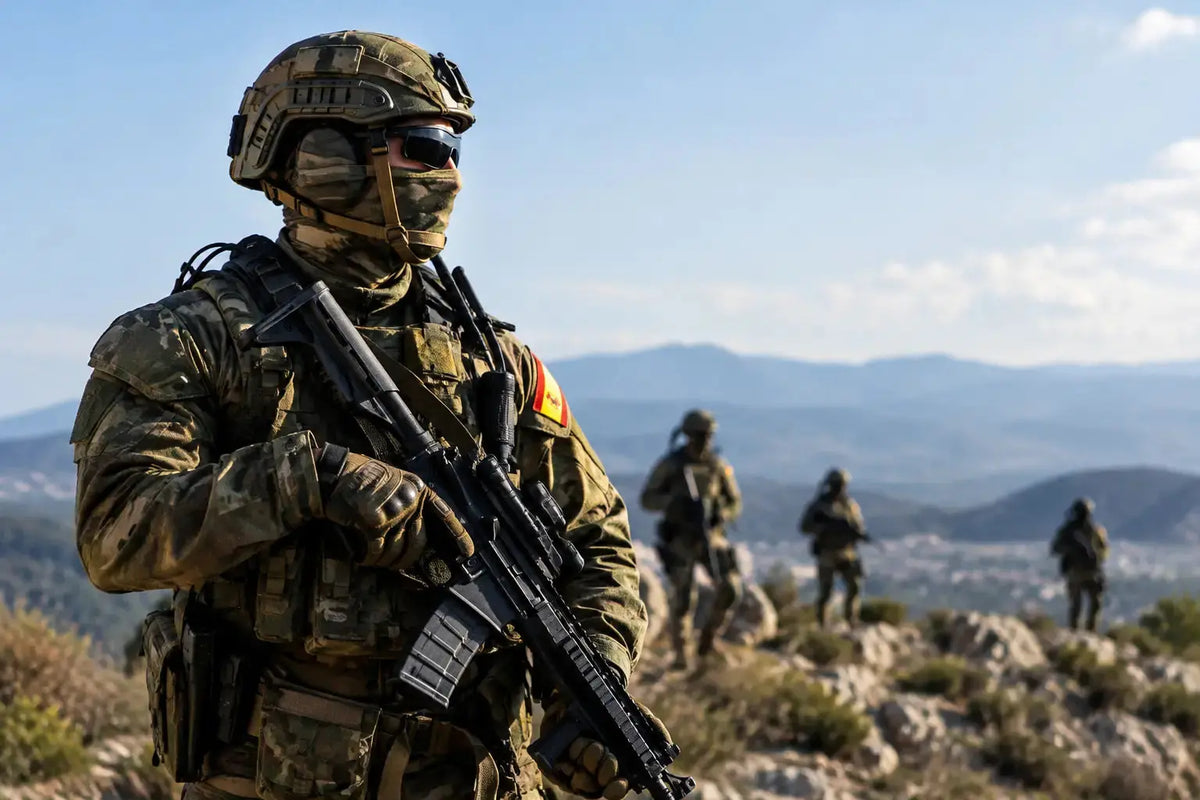
An open parachute in the sky, the roar of an aircraft, and a black beret represent much more than a military specialty. They speak of preparation, discipline, and resolve. The history of the BRIPAC: the elite brigade of the Spanish Army is linked to men and women who have made jumping a way of serving Spain, with a physical and moral standard that has shaped several generations.
The Paratrooper Brigade is one of the most recognizable names in the Spanish Armed Forces. Its prestige does not stem solely from its operational capabilities, but from its own culture: camaraderie, initiative, a spirit of sacrifice, and loyalty to the unit. Values that continue to inspire those who have served, their families, and so many Spaniards who look with respect upon the uniform, the national flag, and military tradition.
The birth of the Spanish paratrooper units
The idea of having troops capable of quickly reaching decisive points by air drop took shape in Spain after World War II. Military parachuting had already shown that it could change the pace of an operation, but also that it required rigorous training and demanding selection. It was not enough to jump: once on the ground, they had to fight, navigate, endure, and act as a team.
In 1947, the Military School of Parachuting was created, a fundamental step in training the first officers and specialists. That effort paved the way for a dedicated force. On October 17, 1953, the I Paratrooper Regiment was born, considered the direct origin of the future Paratrooper Brigade. The date retains profound symbolic value for those who consider Spanish paratrooper tradition their own.
The first unit was named after Roger de Flor, in tribute to the famous Almojarife leader. It was no random choice. The Almojarife warriors evoke boldness, mobility, and determination, qualities sought in those first paratroopers. Over time, that historical reference became permanently incorporated into the unit's character.
From the first Regiments to the BRIPAC
During the 1950s, the paratrooper forces grew and consolidated their structure. New units joined the first Regiment, including the Roger de Lauria Regiment and the Ortiz de Zárate Regiment. The designation of Regiments also connects paratroopers with a deeply rooted tradition in the Spanish Army, where the unit, the standard, and collective honor possess a meaning that goes far beyond the ceremonial.
In 1965, the Paratrooper Brigade was formally established. From then on, the BRIPAC organized a larger capability, prepared to deploy quickly and operate as a cohesive force. Its evolution responded to the needs of each era: changes in doctrine, modernization of equipment, new ways of fighting, and Spain's growing participation in international missions.
Today, the unit is known as the VI Almojarife Paratrooper Brigade. Its name unites the present of the Spanish Army with a historical memory that is not hidden away. The Almojarife reference reminds us that Spain has a long military tradition and that each generation of soldiers receives the duty to live up to those who preceded them.
The jump as a test and a commitment
The parachute jump is the visible emblem of the BRIPAC, but it does not by itself summarize a paratrooper's preparation. After leaving the aircraft, a phase begins that requires composure, technical mastery, and immense confidence in one's comrades. Landing, regrouping on the ground, and completing the mission are all part of the same sequence.
For this reason, paratrooper training is not limited to individual courage. The drive to jump into the void matters, but it is insufficient without discipline. The brigade needs soldiers capable of reacting under pressure, maintaining cohesion, and following orders in complex circumstances. That balance between boldness and method explains much of its reputation.
History of the BRIPAC and its missions
The history of the BRIPAC does not belong solely to exercises, parades, and ceremonies. Its units have participated in operations and missions outside Spain, representing the nation in settings where the professionalism of the Armed Forces has been essential. The Balkans, Afghanistan, Iraq, Lebanon, and other deployments have formed part of that contemporary journey.
Each mission presents different conditions. Some focus on security, others on stabilizing areas affected by conflict, supporting the civilian population, surveillance, or cooperating with allies. Speaking of these operations requires avoiding simplifications: overseas service demands military preparation, but also prudence, adaptability, and respect for Spain's international commitments.
The presence of paratroopers in these missions has projected an image of dedication and competence. Behind every contingent are months of training, logistics, planning, and families who support a silent part of the service from home. Military history is also written in that discreet support, which is as important as the uniform.
Symbols that identify a brotherhood
The paratrooper emblem, the wings, the black beret, the patches, and the names of the Regiments form a language that members of the unit recognize immediately. For those who have served in it, they are not mere aesthetic elements. They hold memories of training, guard duty, marches, comrades, and absences.
The black beret has become one of the most popular symbols of the BRIPAC. Wearing it represents belonging to a unit of high readiness and preparation. It also expresses a shared heritage: whoever receives it knows they carry on their head a tradition forged with effort, not a meaningless ornament.
The motto that accompanies the paratroopers is of special significance: «Desperta ferro». It is the historic battle cry associated with the Almojarife warriors, a call to determination before combat. In today's context, it retains its power as an evocation of alertness, courage, and readiness to fulfill one's duty.
An elite based on standards, not on distance
Calling the BRIPAC an elite brigade does not mean presenting its members as figures apart from the rest of the Spanish people. On the contrary: they come from families, cities, and towns from all over Spain, and they put their capabilities at everyone's service. The difference lies in specific preparation and a readiness that requires personal sacrifices.
The condition of a paratrooper implies passing physical, technical, and psychological tests. However, the most lasting strength is built in everyday life: arriving on time, taking care of equipment, obeying when appropriate, commanding responsibly, and never abandoning a comrade. Real courage does not always take the form of a spectacular gesture. Often, it consists of maintaining composure when exhaustion sets in and the mission demands more.
It is also worth understanding that military units evolve. Means, settings, and defensive needs change. What remains is the core of values that allows a brigade to adapt without losing its identity: honor, loyalty, discipline, and love for Spain.
A living legacy for Spain
The Paratrooper Brigade holds a special place in Spanish military memory because it combines modernity and tradition. Its soldiers operate with methods and equipment appropriate to their time, but they retain names, symbols, and rituals that link back to centuries of national history. That continuity is not empty nostalgia: it serves to remind us that service to Spain has roots and responsibilities.
For many Spaniards, wearing a garment or accessory inspired by the BRIPAC is a way of showing respect for those who have chosen to serve. At La Flamenca de Borgoña, military and national symbols are understood precisely this way: as a visible expression of pride, gratitude, and belonging, always with the respect their meaning deserves.
Remembering the history of the Spanish paratroopers invites us to look beyond the jump and the uniform. It invites us to value the commitment of those who train every day to be prepared when Spain needs them, and to pass on to the youngest that honor, courage, and loyalty continue to be words of weight.


