



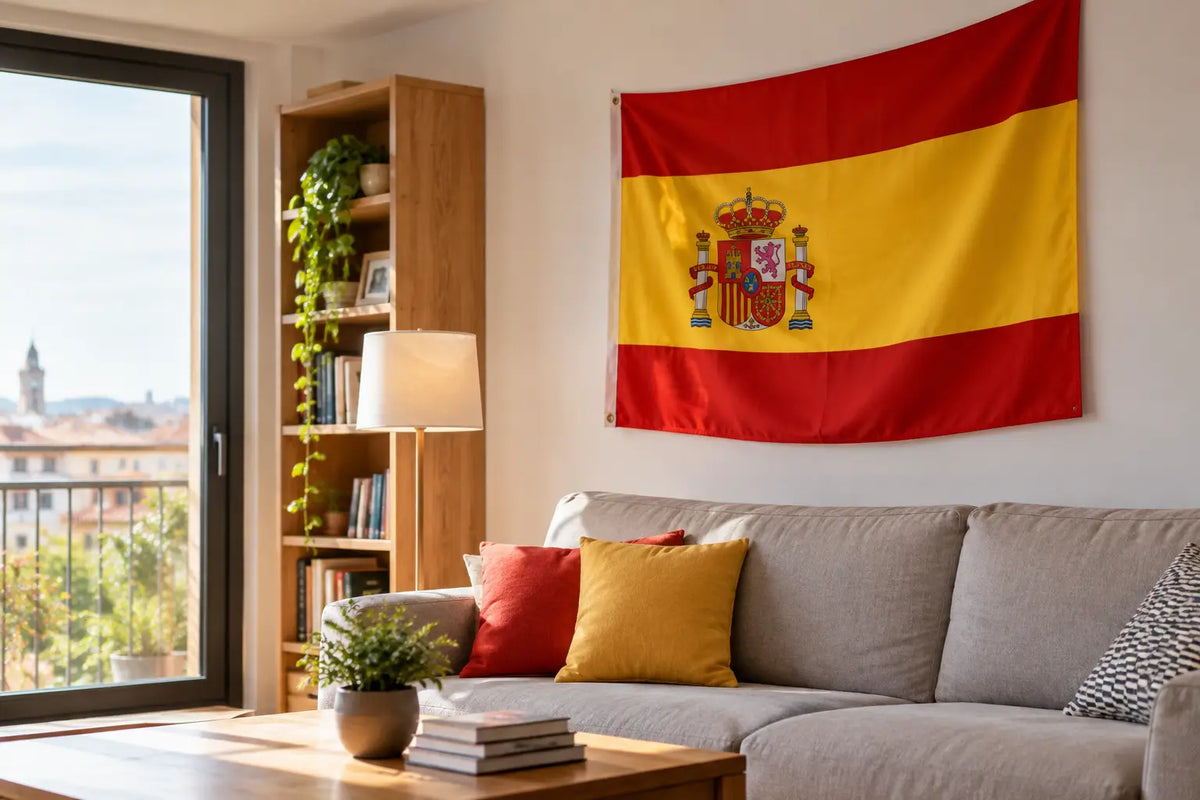
A flag is not a mere decoration. In a Spanish home, it can be a serene and steadfast statement of belonging, memory, and love for our heritage. If you are wondering where to place a flag at home, the best answer does not depend solely on the available space: it matters that it is visible, well cared for, and fits the life lived within those walls.
Hanging it in a thoughtfully chosen place turns a balcony, living room, or entrance into a daily reminder of Spain, its history, and the values that many Spaniards proudly uphold. There is no need to wait for a national holiday, a match, or a specific celebration to display the colors of our flag.
Where to place a flag at home: choose a place with presence
The facade is the most visible place and, for many families, the most natural. A flag on the outside speaks to the street, welcomes visitors, and accompanies the life of the neighborhood. It can be installed on a slanted flagpole next to a window, on a balcony bracket, or on a wall-mounted rod. The essential thing is that it is securely fastened and does not drag or continuously strike the facade.
The balcony also offers a magnificent location. A flag extended from the railing has visual strength and is recognized from a distance, especially on significant dates such as October 12, local celebrations, sporting events, or days of tribute to our Armed Forces and Security Forces. If you place it there, make sure it does not invade common areas or cause inconvenience to neighbors or passersby.
In a single-family home, the garden allows for an even more solemn presence. A vertical flagpole next to the entrance, near the porch, or in an open area gives the flag the place it deserves. It is an excellent option for those who want it to fly freely, although it requires frequently checking the anchoring, the condition of the fabric, and the action of the wind.
The living room: Spanish pride in the heart of the home
Not every flag has to be outside. The living room is the heart of the home and can be the perfect space to incorporate the flag of Spain, the Cross of Burgundy, or a historic banner with personality. In this case, size and format make the difference.
A large flag works well on a wide wall, behind the sofa, above a sideboard, or in a family gathering area. It can be hung flat, framed, or on a decorative rod. A framed piece protects the fabric from dust and provides a more formal presence, especially if combined with family photographs, service memorabilia, historical prints, or religious symbols.
If the living room has a more classic style, a fabric flag with a natural drape can add warmth and character. In modern spaces, however, a clean composition usually works better: a well-tensioned flag, without excessive folds and without surrounding it with too many objects. The flag must lead the ensemble, not be hidden among meaningless decoration.
It is advisable to avoid places exposed to direct sunlight for many hours. Intense light can fade the colors over time. It is also not a good idea to place it near a fireplace, an open kitchen, or areas where it accumulates smoke, grease, or moisture. Taking care of it is also a way of respecting it.
A corner of honor for memories and symbols
There are homes where the flag is part of a corner dedicated to family, service, and tradition. It can be next to a photo of a military grandfather, a medal, an image of the Virgin, a pilgrimage souvenir, or an inherited object. It is not about accumulating symbols, but about giving context to that which represents honor, courage, and loyalty.
In that space, a smaller flag may be more appropriate than a large one. On a stand, in a display case, or accompanying a collection of family objects, it conveys pride without overloading the room. The result should feel lived-in, not staged to impress anyone.
Entrance and foyer: a welcome with identity
The entrance to the home has a special value because it is the first place those who arrive see. A small tabletop flag, a framed textile piece, or a detail with the national colors can turn an ordinary foyer into a welcome with Spanish identity.
This option is especially practical in small apartments, where there is no balcony or where the living room is already very occupied. A clean, well-lit, and protected place is enough. A stand on a console or a frame on the wall can give presence to the symbol without detracting from the functionality of the space.
It is also a good point to incorporate historic flags, such as the Cross of Burgundy, if they are part of your way of understanding Spain and its legacy. The key is to choose a format proportional to the foyer. In a narrow hallway, a flag that is too large may look out of place or get in the way; a vertical or framed piece usually solves it better.
Office, workshop, or personal room
The office is one of the most coherent places to place a flag at home. It is a space for work, study, reading, and reflection, and it can daily remind one of what they strive for. A flag behind the desk, visible on video calls, or on a side wall, gives character without the need for grand gestures.
In a youth room, it is advisable to adapt the format. A fabric flag can accompany a study or sports area, while a cushion, a print, or an accessory with the colors of Spain allows expressing that identity in a more integrated way. For a children's room, choose resistant materials and avoid placing flagpoles or rigid elements within reach of the little ones.
Anyone who has a game room, a conditioned garage, or a workshop can also reserve a wall for their symbols. These are spaces where more personal formats fit: a flag signed on a special occasion, a souvenir from a unit, a Legion emblem, or a banner linked to a family tradition.
How to place a flag with respect and good taste
Before deciding on the final location, look at the home as a whole. The flag should have space around it and enough distance to be appreciated. If it is folded by furniture, covered by a door, or tucked into a dark corner, it will lose all its strength.
Fastening deserves attention. Outdoors, use supports designed for wind and periodically check screws, ropes, and anchors. Indoors, make sure the attachment points do not damage the fabric. Whether you hang it horizontally or vertically, make sure the shield is correctly oriented and that the design maintains a dignified appearance. When in doubt, it is preferable to choose a flag made for that type of display rather than improvise.
You must also accept that an outdoor flag wears out. Rain, sun, pollution, and wind eventually affect the fabric. When it loses color, frays, or shows tears, it is time to remove and replace it. There is no greater respect than keeping it clean, intact, and well presented.
In homeowner associations, developments, or buildings with specific rules, first check the rules regarding elements on facades and balconies. Proudly defending what we are is not incompatible with acting responsibly and maintaining good coexistence.
The flag is not hidden: it is integrated into your home
Every home has its best place. On a balcony, it will be a sign of pride to the outside; in a living room, a presence that unites the family; in an office, an affirmation of principles; and in the garden, a visible tribute to Spain. There is no single correct way to display it, but there is one idea that must be maintained: placing it with respect, conviction, and care.
At La Flamenca de Borgoña, we understand that national, historic, and traditional symbols do not belong in a drawer. They are part of the daily life of those who do not give up their identity. Choose a worthy corner, take care of your flag, and let your home say, without complexes, what you carry inside.


