


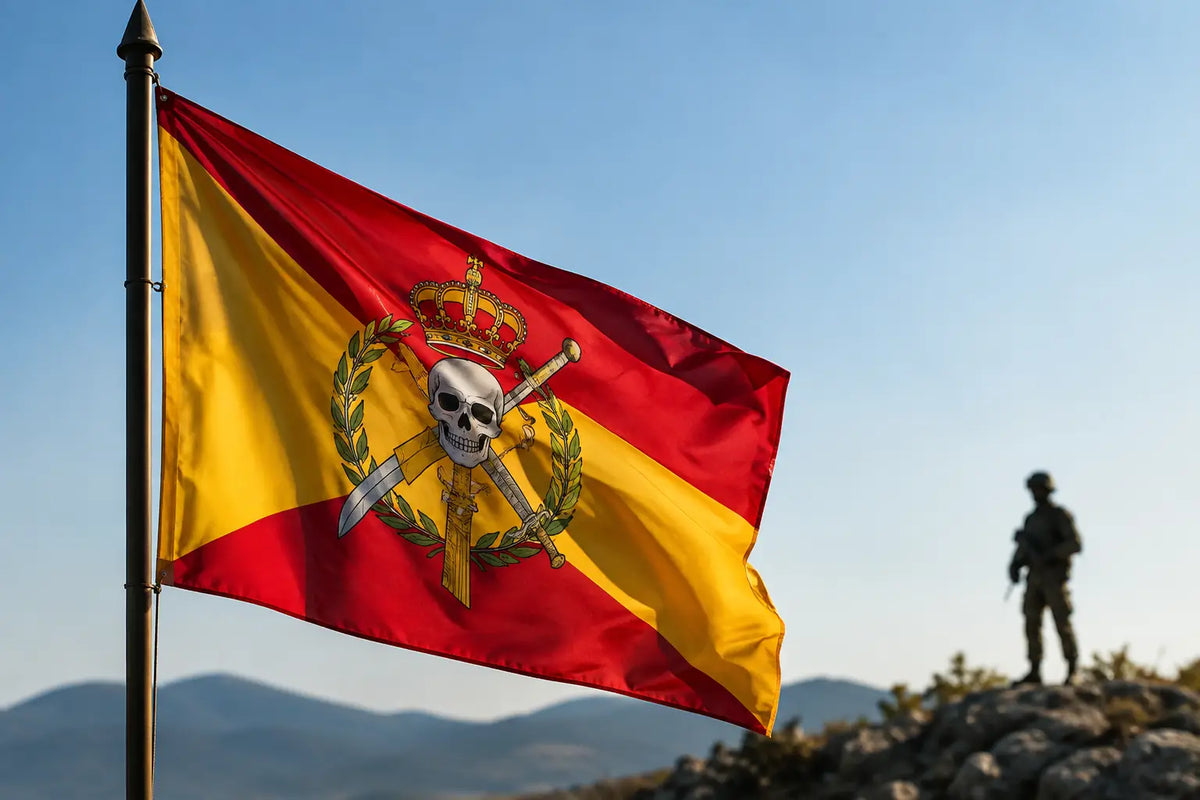
It is not a flag to be viewed from afar or a song to be listened to with indifference. The meaning of the Legion flag: El novio de la muerte refers to a very specific way of understanding service to Spain: with discipline, camaraderie, courage in the face of danger, and loyalty to the fallen. For thousands of Spaniards, these symbols embody a military memory that remains alive in parades, memorial services, brotherhoods, and homes where national pride is expressed without reservation.
The Spanish Legion has a recognizable aesthetic and a powerful identity. Its colors, emblems, mottos, and songs are not mere decorations: they speak of a unit founded in 1920, with its own code of conduct and a tradition that has left a profound mark on the history of Spain. Understanding its symbols requires looking beyond the image and paying attention to what they represent.
What the Legion flag represents
It is worth making a clarification: there is no single flag that summarizes all Legion symbolism. The Legion has national colors, unit colors, pennants, and emblems that may vary depending on the Tercio, the Bandera, or the specific formation. However, when people speak of the Legion flag, they are usually referring to the colors that identify its units and the shared imagery surrounding them.
First, there is Spain. The national flag holds a central place because a Legionnaire swears or promises service to the Fatherland and the Constitution. Red and yellow do not appear as a circumstantial decoration, but as a sign of belonging to a nation with history, institutions, and a continuity that deserves to be defended.
Alongside it, the Legion colors usually incorporate the unit emblem: the crossed rifle, crossbow, and halberd, united under a crown. Each element evokes a different military tradition and expresses the union of arms, eras, and wills. It is not about empty nostalgia. The emblem serves as a reminder that the Legion recognizes itself as an heir to Spanish military history, but also as a modern body at the service of Spain.
The presence of the name of a Tercio, a Bandera, or a specific date adds another layer of meaning. A color does not only identify a unit on the ground. It safeguards its memory, its missions, its decorations, and the memory of those who served under it. That is why respect for the colors is an essential part of military culture: it represents all those who have honored it with their conduct.
The meaning of the Legion flag and El novio de la muerte
The relationship between the Legion flag and El novio de la muerte is emotional, historical, and ceremonial. The song does not literally explain a specific color, but expresses the spirit that many Spaniards associate with the passing of Legionnaires alongside their colors: steadfastness, sacrifice, and a brotherhood that leaves no one behind.
El novio de la muerte was born as a cuplé in 1921 and soon became linked to the Legion. Its lyrics tell the story of a Legionnaire who finds death as his faithful companion after losing the love of a woman. It is a poetic, intense story marked by the language of its time. To reduce it to a literal exaltation of death would be to fail to understand its context or the military tradition to which it was incorporated.
In the Legionnaire universe, death appears above all as the extreme possibility that accompanies those who serve on the front line. The song does not celebrate the end of life, but the will to fulfill duty even when there is risk. It speaks of not retreating, of supporting one's comrade, and of preserving honor when circumstances are difficult.
That interpretation fits with the Legionnaire Creed, whose principles have defined the public character of the unit. The spirit of camaraderie, love of the flag, discipline, and readiness to go into battle are not isolated phrases. They form a demanding ideal of conduct, which unites Legionnaires from different generations and inspires respect among many citizens.
When El novio de la muerte is played at a memorial service, especially on dates of great tradition such as Holy Week in Málaga, the silence and emotion do not arise solely from the music. They arise from what is remembered: those who served, those who did not return, and the families who have upheld that vocation of service. The flag present at that moment is not a decorative object; it is a visible representation of that shared promise.
Honor, courage, and loyalty: the ideas it brings together
The symbolic power of the Legion is best understood through three words: honor, courage, and loyalty. They are widely used terms, but they acquire a real meaning when linked to deeds and responsibilities.
Honor implies answering for one's own actions. In the Legionnaire tradition, it means acting with integrity, respecting the uniform, keeping one's word, and representing the unit with dignity. It does not depend on applause or trends. It is an inner requirement that is demonstrated precisely when no one is watching.
Courage is not equivalent to not feeling fear. Courage consists of acting despite fear when duty, the protection of others, or the mission requires it. This is a decisive difference. Legionnaire epic inspires emotion because it recognizes danger, but places above it the decision not to abandon the responsibility assumed.
Loyalty, for its part, looks to Spain, the unit, and the comrade. Legionnaire camaraderie is one of the best-known traits of its creed. Those who have served alongside others know that mutual trust is not a slogan: it is a human and operational necessity. That is why so many family members and supporters find in these symbols a way to pay tribute to specific people.
A tradition carried with respect
Wearing a flag, a bracelet, a T-shirt, or a Legion emblem is a legitimate way to show affection for Spain and recognition of its Armed Forces. But it also invites one to act with respect. Military symbolism does not need to be loud to have a presence: its strength comes from what it represents.
Each person can experience that bond differently. For some, it will be the memory of a father, a mother, a grandfather, or a friend who served in the unit. For others, it will be the emotion of seeing the Legionnaires march or listening to El novio de la muerte. And for many, it will be a clear declaration of love for Spain, its history, and those who have placed themselves at its service.
It is also important to distinguish between knowing a symbol and turning it into a mere costume. Legionnaire aesthetics have character, but their depth lies in the values that sustain them. Before wearing an emblem, it is advisable to know what body it represents, what its color means, and why its traditions inspire so much respect. That understanding turns an external gesture into an authentic expression of belonging.
The flag as shared memory
Flags accompany peoples in their solemn moments. They mark celebrations, farewells, victories, mourning, and tributes. In the case of the Legion, its colors evoke a history of service and the identity of men and women who have embraced a unique military vocation within the Army.
That is why its meaning cannot fit into a single image or a definitive phrase. It is in the emblem, in the firm step, in the color guarded, in the memory of the fallen, and in the commitment of those who continue to serve. El novio de la muerte puts music to that memory, with lyrics that have transcended generations and still move those who listen to it with respect.
Spain preserves symbols that do not ask permission to exist or need to be diminished to remain relevant. The Legion flag and its anthem remind us that identity is cared for with knowledge, with gratitude, and with the loyalty of those who know how to honor what they have received.


