


Products with the Cross of Burgundy
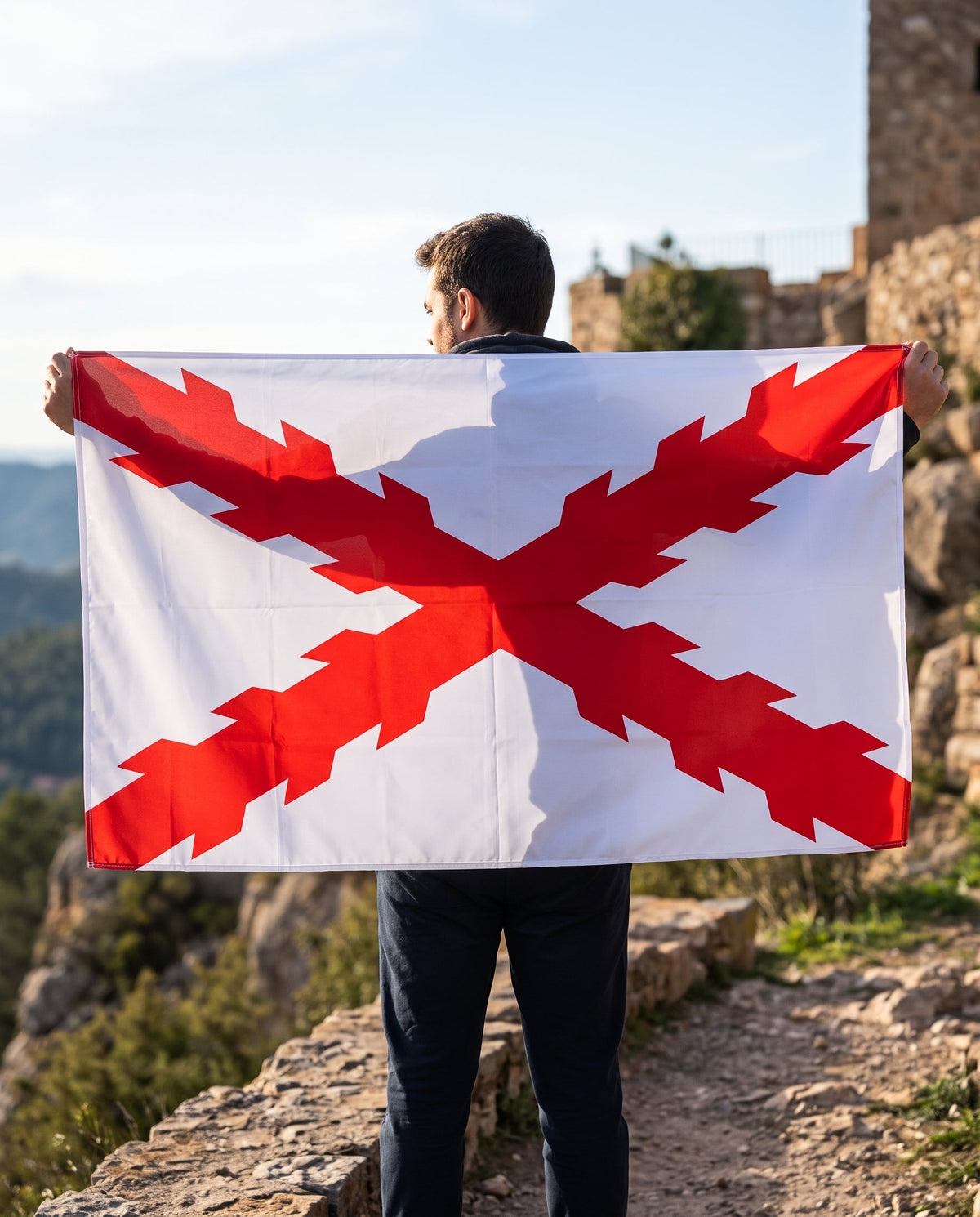
The Cross of Burgundy flag, or Burgundy Saltire, is a representation of the St. Andrew's Cross, in which the trunks form a cross with their knots, at the places where the branches were cut. And in the La Flamenca de Borgoña online store we have hundreds of products with the Cross of Burgundy.
Clothing with the Cross of Burgundy
At La Flamenca de Borgoña we have countless products with the Cross of Burgundy, because this symbol is part of our brand logo.
In our online store you will find clothing such as shirts, polo shirts, t-shirts and jackets with the Cross of Burgundy.
Also basic accessories such as keychains and bracelets with the Cross of Burgundy.
Likewise, we offer you many other products such as towels, swimsuits, flip-flops, briefs, bikinis, and much more with the Cross of Burgundy.
History of the Cross of Burgundy
Being Saint Andrew the patron of Burgundy, the Cross of Burgundy was the emblem used by the troops of John the Fearless in the Hundred Years' War. After Mary of Burgundy married Maximilian I, Holy Roman Emperor, her eldest son, Philip, called "the Handsome", in turn married Joan I of Castile, called "the Mad", becoming Philip I of Castile.
Philip displayed the Cross or Saltire of Burgundy on the uniforms and flags of his retinue. It was then inherited and expressly adopted by his son, Charles I of Spain and V of the Holy Roman Empire, the result of Philip's marriage to Joan I of Castile.
The Cross of Burgundy in Spain
The Cross of Burgundy has been included in the coats of arms and flags of Spain, both land and sea, since 1506, the time of its introduction with the Burgundian Guard of Philip the Handsome. Although it disappeared from the Royal Coat of Arms of Spain during the reign of Philip VI and from his standard,1 many current flags, pennants and standards of the Spanish Army still feature this emblem. A clear example is the pennants and standards of the Royal Guard.
The Cross of Burgundy is the origin of the fluke that marks the tails of the aircraft of the Spanish Air Force,2 and of the Airborne Forces of the Spanish Army.
As a vexillological symbol, it has been the most used until 1785 in Spanish flags.
On land, this flag, white with the Cross of Burgundy in red, perhaps flew for the first time as a Spanish insignia in the Battle of Pavia in 1525 (although the red saltires were plain, without knots), and it is the most characteristic of those used by the Spanish Tercios and infantry regiments of the Hispanic Monarchy during the 16th, 17th, 18th centuries and the early 19th century.
Since Charles I, each company has its own flag, in which the cross appeared on backgrounds of very diverse shapes and colors (which sometimes included hieroglyphs or heraldic motifs of the commanding officer). Upon accessing the throne Philip II, he ordered that, in addition to the flags of each company, each tercio carry another one in chief of yellow color with the saltires of Burgundy in red. Despite this variety, white was the most used color as a background, especially in the regimental flags. In this regard, a decree of Philip V given on February 28 of 1707 said:
And it is my will that each body bring a white regimental flag with the Cross of Burgundy, according to the style of my troops, to which I have ordered to add two castles and two lions, distributed in four whites, and four crowns that close the tips of the saltires.
At sea, flags with the saltires of Burgundy have been used as bow flags and as ensigns of the Armada and the Merchant Marine.
It was also the "viceregal standard" in the viceroyalties of New Spain.3
During the Hispanic American revolutions, the Ecuadorian patriots of the First Autonomous Government Junta of Quito used a flag of gules (red) with the Cross of Burgundy charged in argent (white), as an affirmation of the past and as a historical continuity of the Indian Kingdoms, after the fracture of the Spanish Monarchy by the Napoleonic invasion. This flag is known as the "flag of August 10, 1809".
Today many American flags recall in their design the Cross of Burgundy and its Spanish past, such as the flag of the city of Valdivia, Chile, the flag of the department of Chuquisaca in Bolivia, or those of the United States states of Florida and Alabama. The flag flies over the castle San Felipe del Morro and the fort San Cristóbal in San Juan, Puerto Rico. Finally and last but not least, the flag of the Infantry Regiment 1 «Patricios» of the Argentine Army, since 1807 to our days.
Buy now in the La Flamenca de Borgoña online store your products with the Cross of Burgundy.


