



A town square, a market, a procession, or a night at a fair reveals a simple truth: the closest security has always had a local face. The history of the municipal police: the evolution of local forces is not just a succession of uniforms, regulations, and names. It is the history of how Spanish municipalities have protected coexistence, heritage, customs, and the daily lives of their residents.
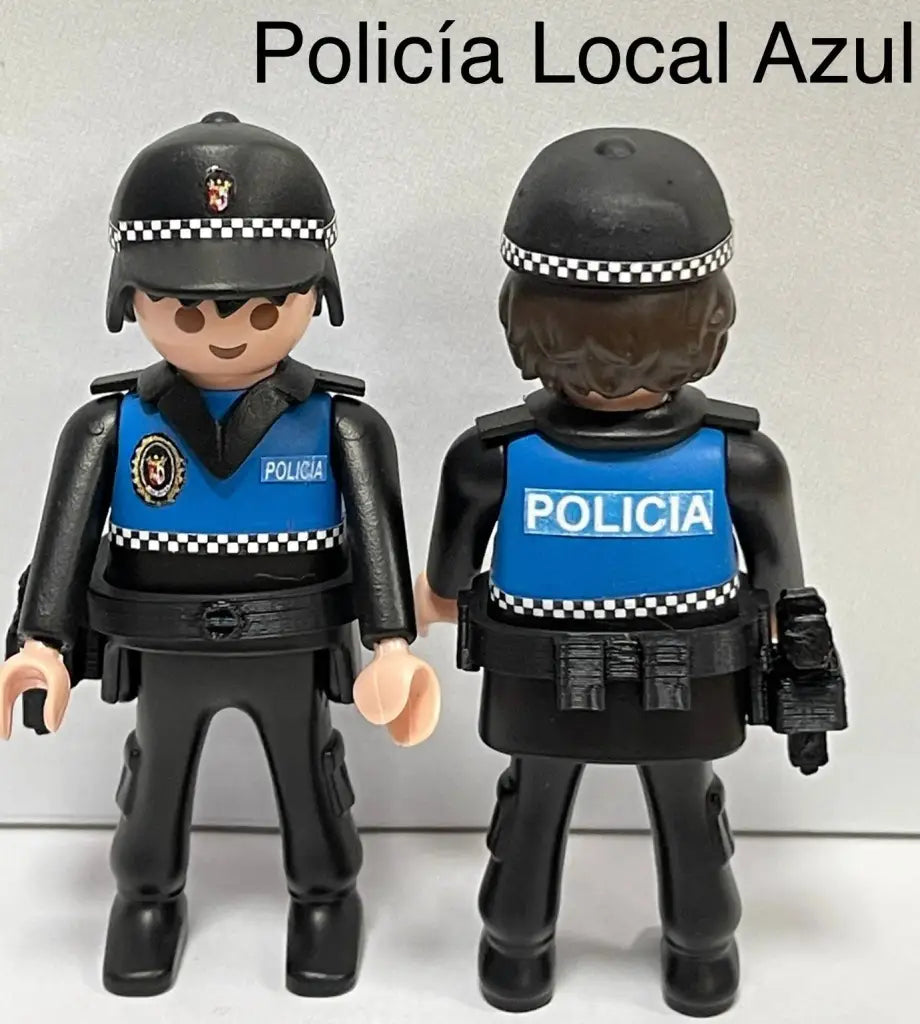
Playmobil Local Police here: https://laflamencadeborgona.es/products/playmobil-custom-policia-local-azul-personalizado
Today we know these officers as the Local Police or Municipal Police, depending on the autonomous community and municipality. Their work encompasses much more than directing traffic: they respond to incidents, assist those in need, enforce local ordinances, and are present at the events that bring life to every town and city. To understand their current role, it is useful to look back at the town councils and guards who defended municipal authority when Spain was organized around its towns, cities, and communities.
Medieval town councils: the origin of local security
During the Middle Ages, there was no municipal police force like the one we understand today. However, town councils had their own mechanisms for maintaining order. In towns with their own charters, local authorities appointed officials responsible for watching streets, gates, markets, and nearby roads. Bailiffs, town guards, beat officers, and watchmen performed different duties, but they shared a mission: to ensure compliance with the community's agreements and the council's jurisdiction.
Reality depended greatly on the size and importance of each settlement. A city with commercial activity, walls, and fairs needed permanent surveillance. In a smaller town, protection relied on the residents, the brotherhoods, and the mobilization of armed men when a conflict arose. There was no national uniformity, but there was a solid idea: the municipality had direct responsibilities for its public peace.
The brotherhoods played a prominent role, especially in Castile. They were associations of cities and towns that collaborated to pursue crimes on the roads and stop abuses in territories where ordinary justice did not always arrive quickly. The Holy Brotherhood, promoted by the Catholic Monarchs, reinforced this cooperation and left a lasting mark on the organization of security. Its scope exceeded the purely municipal, although it stemmed from a tradition of shared responsibility among local communities.
From bailiffs to modern urban order
With the consolidation of the Hispanic Monarchy, cities maintained surveillance figures linked to town halls and justice. Bailiffs executed orders, arrested criminals, and assisted governors and mayors. There were also field guards, night watchmen, and those responsible for controlling supplies, weights, measures, and public health.
During this period, public order was not clearly separated from daily administration. Watching a market meant preventing fraud, stopping brawls, and ensuring supplies. Looking after the streets included fighting fires, controlling the streetlights when they existed, and pursuing those who disturbed the peace of the neighborhood. Local security was therefore built on proximity and knowledge of the area.
At the end of the 18th century and the beginning of the 19th, urban growth posed new demands. Cities needed more stable services, especially for nighttime surveillance. The night watchmen became a popular figure: they patrolled the streets, announced the time and weather, warned of dangers, and assisted residents. Their image is part of the Spanish urban memory and anticipates an essential function of the municipal police: to be where ordinary life takes place.
The evolution of local forces in the liberal state
The 19th century was decisive for the evolution of local forces. The creation of modern town halls, administrative reforms, and the development of a more defined state structure forced a reorganization of competencies. In 1844, the Civil Guard was born, with a fundamental mission in the security of the rural environment and roads. Its appearance did not eliminate municipal needs, but rather helped define a division of functions among institutions.
Cities, increasingly populated and complex, organized urban guards and municipal forces with varied names. Their duties included patrolling public roads, enforcing decrees and ordinances, guarding municipal buildings, controlling public events, and assisting the authorities. Madrid, Barcelona, Seville, and other large cities gradually consolidated more recognizable workforces, while many towns maintained modest structures adapted to their resources.
It is not useful to imagine a linear process or one that was identical throughout Spain. Each municipality evolved at its own pace, conditioned by its population, economy, communications, and institutional tradition. In some places, the local police had a continuous presence; in others, surveillance duties fell for years on bailiffs, watchmen, or guards with limited powers. That diversity still explains the richness of local names and customs.
Uniform, authority, and service to the resident
During the 20th century, municipal forces moved toward greater professionalism. Standardized uniforms, specific training, communication systems, and shift-based organization became widespread. The local officer ceased to be merely a street watchman and took on technical tasks related to traffic, police reports, civil protection, administrative policing, and collaboration with other security forces.
The uniform has a value here that goes beyond the visual. It represents legitimate authority, availability for service, and commitment to the community. For many families linked to the security forces, those emblems evoke difficult days, vocation, and a responsibility that rarely understands schedules. Social recognition does not come solely from an insignia, but from the daily conduct of the person who wears it.
The expansion of the automobile notably transformed priorities. Regulating intersections, preventing accidents, and organizing traffic became a central competency in cities. Then came new challenges: the increase in mass events, the protection of school environments, attention to domestic violence, neighborhood mediation, and emergency management. The municipal police had to specialize without losing their most valuable trait: knowing the neighborhoods, the streets, and their residents firsthand.
Democracy, autonomy, and the Local Police
The Constitution of 1978 and the development of the autonomous state opened a new chapter. The autonomous communities assumed competencies to coordinate the local police and passed their own laws within the state framework. This organization explains why there are differences in scales, categories, names, training, and symbols, without the disappearance of a common mission of municipal service.
Contemporary legislation places local police as armed institutions of a civil nature, with a hierarchical structure and organization, under the authority of town halls. Their functions are carried out in collaboration with the State Security Forces and Bodies and with the autonomous forces where they exist. Coordination is essential: security problems do not always end at the boundary of a municipal district.
The limits must also be understood. A Local Police force does not replace the Civil Guard or the National Police, just as these forces cannot fully reproduce the everyday knowledge possessed by an officer stationed for years in a municipality. Effectiveness comes from cooperation, respect for competencies, and agile communication when a situation requires different means.
Proximity is not an abstract idea
Closeness is made concrete in small and decisive acts: assisting a disoriented elderly person, intervening in a neighborhood conflict, securing a popular race, accompanying a procession, locating a minor, or clearing the way for an ambulance. These are services that rarely make major headlines, but they sustain the trust of a community.
In towns and cities in Spain, local officers also participate in moments where tradition and security walk together. Pilgrimages, fairs, religious celebrations, patron saint festivals, and sporting events require planning, prevention, and serenity. Defending these celebrations is also protecting a way of coexistence and a living heritage that belongs to everyone.
Memory, respect, and pride in local forces
Talking about the history of the Municipal Police requires recognizing a plural institution, forged by centuries of town council life and adapted to every transformation of Spain. Their names have varied, their means have changed, and their competencies have been refined, but one obligation remains: to be at the service of the resident and the law from the front line of everyday life.
Anyone who feels respect for our security forces understands that honor is not proclaimed solely on great occasions. It is demonstrated in the early morning shift change, in discreet help, in patrolling under the rain, and in calm firmness when it is time to protect. Remembering that trajectory is a way of valuing those who, from every town hall, continue to care for what unites a community.


