


Few military images evoke such immediate identification as those of the Legion. The flag of the Spanish Legion, its history, and the evolution of its emblem represent much more than decorative elements: they express a way of understanding service to Spain based on discipline, sacrifice, camaraderie, and honor. For legionnaires, veterans, families, and supporters, these symbols remain a living presence at military ceremonies, religious celebrations, and in homes where respect for our history is preserved.
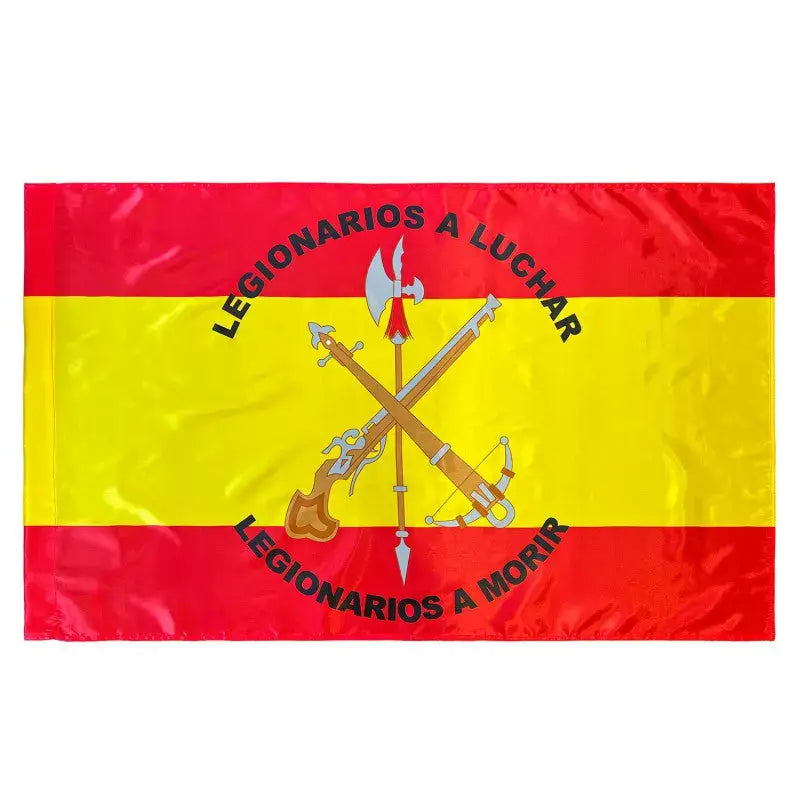
Spanish Legion flag, Legionnaires to fight, Legionnaires to die: https://laflamencadeborgona.es/products/bandera-de-la-legion-espanola-150x90-cm-saten?utm_source=copyToPasteBoard&utm_medium=product-links&utm_content=web
The birth of the Legion and its first symbols
The Spanish Legion was born in 1920 under the name Tercio de Extranjeros, driven by Lieutenant Colonel José Millán-Astray. Its creation met a specific military need in the campaigns in North Africa, but from the very beginning it was conceived as a unit with its own character, its own mystique, its own internal rules, and a recognizable image.
The name Tercio was no coincidence. It deliberately evoked the old Spanish Tercios, those infantry units that for centuries projected Spain's military power across Europe and the Mediterranean. This historical reference helped build a corps spirit that depended not only on the uniform or training, but on the awareness of belonging to a tradition of national service.
In its early years, the unit's insignia was framed within the organization and regulations of the Spanish Army. It is useful here to distinguish between two concepts that are often confused. A military flag is an official standard, linked to the Nation and the oath of its members. An emblem is the distinctive sign of a corps or unit. In the popular imagination, both appear together, because the legionary emblem is reproduced on banners, badges, clothing, souvenirs, and commemorative flags.
Spanish Legion flag: history and evolution of the emblem
The national standard holds a central place in Spanish military tradition. The red-and-yellow flag represents Spain, and before it the commitment to defend the homeland is renewed. The units of the Legion, like the rest of the Armed Forces, maintain that essential link with the national flag, which must not be confused with the banners, standards, or distinctive items of each unit.
The banner, for its part, identifies a specific unit and serves as a ceremonial and moral point of reference. In parades, formations, and solemn ceremonies, it is not a mere piece of cloth: it marks a continuity between those who served before and those who maintain the commitment today. That is why the presence of the legionary emblem on different media carries weight that transcends aesthetics.
The classic emblem of the Legion is recognized by the combination of three historical weapons: the arquebus, the crossbow, and the halberd, usually arranged in a cross and topped by the royal crown. Each refers to an era of Spanish military history and, together, they condense a will to endure. It is not a matter of literally reconstructing the weapons of the Tercios, but of preserving their memory and projecting it onto a unit created in the 20th century.
The crossbow recalls the antiquity of the Iberian warrior tradition. The arquebus refers directly to the Spanish infantry of the Early Modern period, when the Tercios achieved international fame for their resistance and effectiveness. The halberd, a weapon of guard and command, adds a ceremonial and authoritative dimension. Above the whole, the crown expresses the institutional link with the Crown and with the historical continuity of Spain.
Over time, the design has undergone adaptations for embroidery, patches, metal badges, pennants, and graphic uses. It is normal for small variations in line, proportion, or color to exist depending on the era and the medium. The important thing is that the fundamental elements are preserved and make the emblem immediately recognizable. Evolution has not erased its essence, but has allowed it to remain present in everyday life without losing its historical roots.
The color green and the legionary identity
When thinking of the Legion, green holds a prominent place. The green legionnaire shirt, one of the unit's best-known images, has turned that color into a shared mark of identity. However, it is advisable not to reduce all the symbolism of the Legion to a single color or assume that every green flag with the emblem has official status.
In the civil and commemorative sphere, flags, decorative banners, and textile items in legionnaire green, with the emblem embroidered or printed, are common. They are ways of expressing affection, respect, and belonging. Their value is symbolic and emotional, but they do not replace the national flag or the official standards that belong to the military units.
This difference matters because respect for symbols begins with knowing them. A commemorative flag can accompany a veterans' gathering, a pilgrimage, a social club, or a personal space. In contrast, official standards have rules of use, custody, and ceremony that correspond to their institutional status. Admiring the Legion also means treating its symbols with seriousness.
From the barracks to shared memory
The power of the legionary emblem is not explained solely by its antiquity. It also stems from the episodes in which the Legion earned a lasting place in the memory of the Spanish people: the African campaigns, the defense of difficult positions, its subsequent missions, and a way of marching that conveys firmness, unity, and determination.
To this is added its close relationship with certain religious traditions, especially with the image of the Christ of Good Death. The Legion's participation in Holy Week ceremonies, and in a very well-known way in Málaga, has turned that union between faith, memory, and service into a deeply popular image. The steady pace, the singing of El novio de la muerte, and the presence of the emblem create a scene that many Spaniards recognize as part of their emotional heritage.
Not everyone approaches the symbol from the same experience. For a veteran, it may recall years of service and comrades. For a family member, it may be a way to honor a career. For those who admire the history of Spain, it represents the legacy of an Armed Forces that has served the Nation in demanding circumstances. The meaning changes depending on the experience, but one common idea remains: loyalty to Spain.
How to display the emblem with respect
Wearing the emblem of the Legion on a T-shirt, a cap, a bracelet, or a decorative flag does not require having belonged to the unit. It does require understanding that it is not an empty decoration. It represents men and women who have embraced a vocation of service and a unique discipline within the Spanish Army.
That is why the choice of context matters. In a home, an office, a family gathering, or a celebration linked to military tradition, a legionary flag can be a clear declaration of affection for Spain and its institutions. On an everyday garment, it can express pride without the need for grand speeches. The key is to use carefully crafted designs, avoid disrespectful distortions, and always distinguish commemorative items from official symbols.
It is also advisable to pay attention to the visual quality of the emblem. The weapons must appear identifiable, the crown must maintain a proper proportion, and the colors must respect the strength of the whole. A historical symbol loses its presence when it becomes a caricature. In the face of trivialization, the best response is to choose pieces that convey dignity, memory, and pride.
At La Flamenca de Borgoña, we understand that the symbols of Spain do not belong in a silent display case. They can accompany an everyday journey, a gift to a family member linked to the Army, or the decoration of a space where national history holds a place of honor. Displaying the legionary emblem with knowledge is a way to keep alive a heritage of value, discipline, and loyalty that continues to speak powerfully to those who love Spain.


