


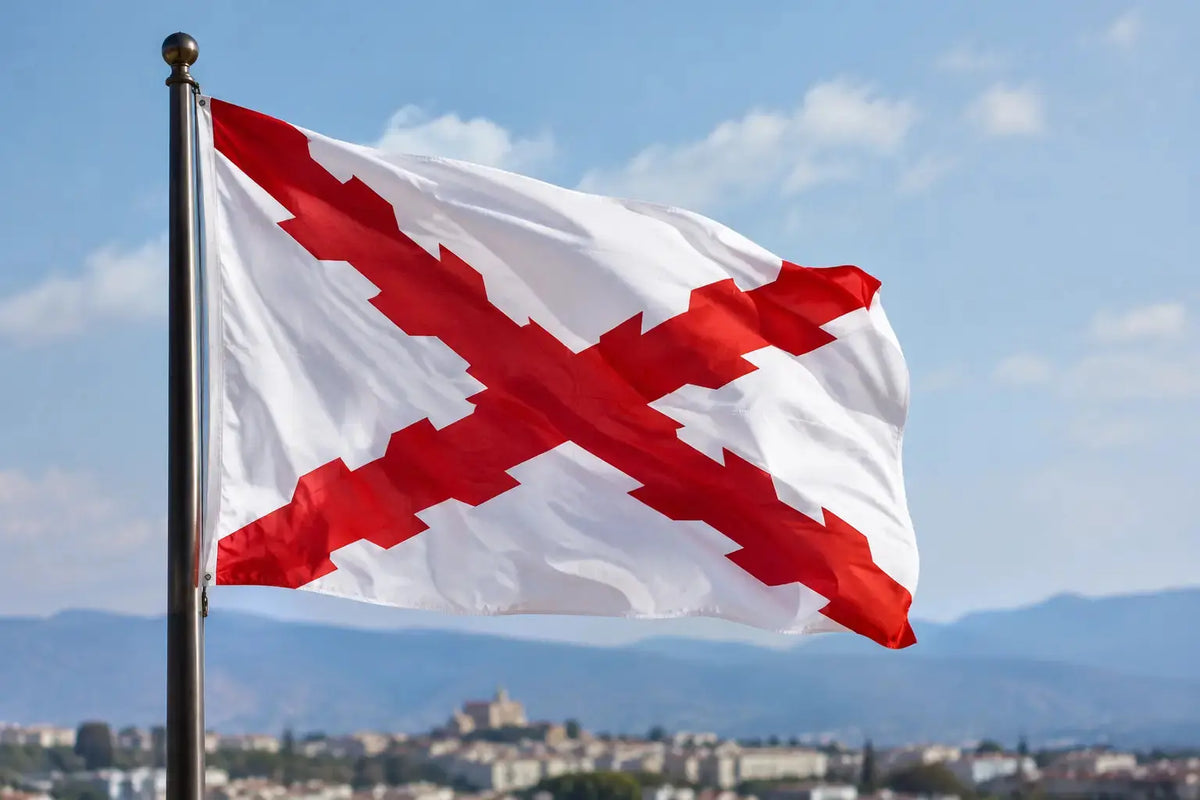
A flag with red spokes on a white background stands out from a distance among thousands of people. It is no coincidence. When someone asks why the Cross of Burgundy is used at current demonstrations, the answer cannot be reduced to a single political label: it speaks of history, of shared memory, and of a visible determination to affirm Spain, its continuity, and its unity.
For many Spaniards, the Cross of Burgundy is not a decoration or a museum relic. It is an emblem that reminds us that our history did not begin yesterday and that national identity can be defended with pride, respect, and public presence. At a demonstration, where every banner and every flag communicates a position, its visual and symbolic strength explains why it continues to wave.
The origin of the Cross of Burgundy in Spain
The Cross of Burgundy is a representation of the Cross of Saint Andrew: two crossed trunks or branches, usually red, with their characteristic knots. It came to the Hispanic Monarchy linked to the Burgundian heritage of Philip the Fair and gradually became, from the beginning of the 16th century, one of the most recognizable military ensigns of the territories of the Crown.
For centuries, it accompanied Spanish armies, fortresses, ships, and units in Europe, America, Asia, and Africa. It was not a flag limited to a specific place: it identified a vast Hispanic Monarchy, formed by different peoples and territories united by a common loyalty. That is why its image has become associated with effort, service, courage, and the defense of Spain.
It is important to speak with historical accuracy. The Cross of Burgundy was not the only ensign used by Spain at all times, nor did it identically replace later flags. The red-and-yellow flag was initially established for the Navy at the end of the 18th century and eventually became the national flag. Even so, the Burgundian cross remained in military, historical, and traditional use, and it never ceased to hold a powerful place in the Spanish imagination.
Why is the Cross of Burgundy used at current demonstrations?
At current demonstrations, this cross serves as a declaration of continuity. Those who carry it usually want to express that they consider themselves heirs to a long history, predating political fashions and attempts to fragment the national narrative. Its presence says, without the need for many words, that Spain has roots, symbols, and a memory that deserve to be known and defended.
It is also used for its ability to bring people together. The national flag represents constitutional and contemporary Spain; the Cross of Burgundy adds a historical reference that connects with military tradition, Hispanidad, and the memory of those who served under its spokes. Both can appear together because they are not necessarily in competition: they speak of different stages of the same nation.
At rallies for the unity of Spain, tributes to the Armed Forces, acts of support for the Civil Guard or the National Police, and patriotic gatherings, its use takes on a particularly clear meaning. It is a way of making visible an adherence to values that many citizens consider non-negotiable: honor, loyalty, sacrifice, order, and belonging.
A visible symbol against collective amnesia
Demonstrations are spaces of collective expression. In them, flags serve a practical purpose: they allow people to recognize one another, convey a message, and build community. The Cross of Burgundy is especially effective because its design is simple, recognizable, and steeped in history. Its red spokes do not go unnoticed and immediately evoke a Spanish tradition that has spanned centuries.
But its strength does not depend solely on aesthetics. In an era in which part of the public debate presents Spanish history through the lens of guilt or contempt, many people raise this ensign as a response to collective amnesia. Not to deny the nuances of history, but to reject the idea that loving Spain, respecting its symbols, or remembering those who defended it should cause shame.
Carrying it can therefore be a gesture of cultural vindication. It affirms that the nation is not an uncomfortable abstraction, but a living heritage made up of language, family, popular faith, customs, institutions, landscapes, and shared experiences. For a Spaniard living abroad, it can also be a very direct way of maintaining a connection with their homeland.
Shared history, diverse meanings
Being faithful to the truth requires acknowledging that no historical symbol has a single meaning for everyone. The Cross of Burgundy has appeared in military, monarchist, Carlist, religious, and traditionalist contexts. Each person who carries it may do so from a different perspective. For some, it primarily represents the Hispanic Monarchy; for others, the legacy of the Tercios; for others, the defense of national unity or an attachment to a traditional Spain.
This diversity does not diminish its value. On the contrary, it demonstrates the depth of the symbol. Reducing the Cross of Burgundy to a single ideology or using it to automatically disqualify anyone who carries it is a biased simplification. Flags have history, and Spanish history is too rich to confine one of its emblems to a simple label.
It also depends on the context. A Burgundian cross does not communicate exactly the same thing in a historical reenactment, at a pilgrimage, on a balcony during a significant date, or at a civic demonstration. The setting, the other ensigns present, and the purpose of the event help to clarify the message. Even so, the core remains: the evocation of a historical Spain and an identity that refuses to remain invisible.
Civic patriotism and respect for symbols
Carrying a flag in the street implies responsibility. Anyone who displays the Cross of Burgundy at a rally represents, in the eyes of many, a way of understanding Spain. That is why it should be done with serenity, firmness, and respect. Defending national unity does not require insulting anyone; it requires knowing how to explain what is being defended and why it deserves to be preserved.
A solid patriotism is not based on ignoring the complexity of the past, but on embracing it without compromise. It can acknowledge both its lights and shadows without accepting that the achievements, sacrifices, and loyalties that built a common nation be erased. The Cross of Burgundy reminds us precisely of this historical dimension: there were Spaniards who served under it in difficult circumstances, far from home and with a sense of duty that still inspires.
It is also useful to distinguish between an assertion of identity and empty provocation. A flag gains greater dignity when the person who carries it knows its origins, respects its use, and accompanies it with consistent behavior. The strength of a symbol does not lie in shouting louder, but in firmly upholding what it represents.
An ensign that continues to speak to Spaniards
The continued presence of the Cross of Burgundy in the streets demonstrates that historical symbols are not dead. Settings, debates, and generations change, but some images continue to convey something essential to those who recognize in them their own heritage. Its red spokes continue to unite past and present because they evoke service, tradition, and an idea of Spain that refuses to disappear from the public sphere.
Before carrying it to a demonstration, a patriotic event, or a family celebration, it is worth learning its history. That way, it will not be just a striking flag: it will be a conscious way of honoring a shared history and affirming, with respect and pride, that Spain is also defended by remembering it.


