



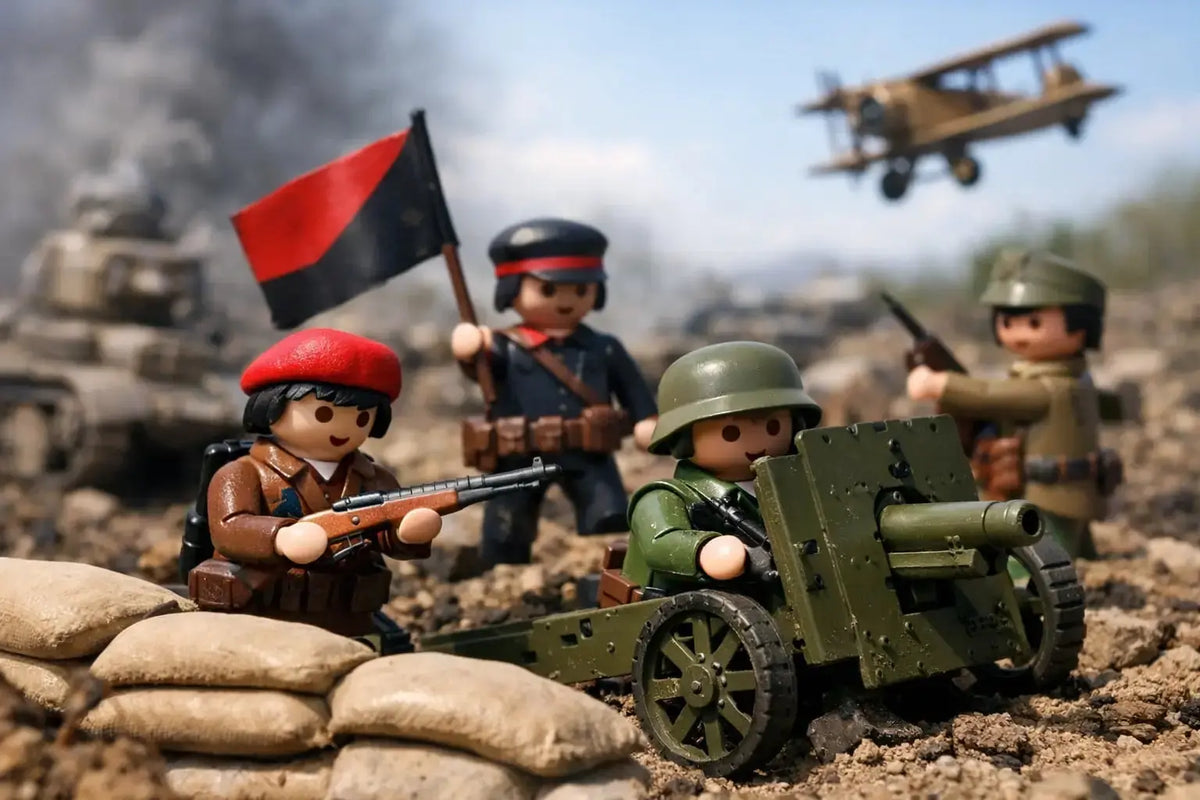
A search for Playmobil Spanish Civil War is not just about figurines, uniforms, and miniature accessories. It speaks of an era that remains present in many Spanish families, of symbols that demand context, and of a collecting hobby that, when properly understood, can bring history closer without turning pain into a mere backdrop.
The Civil War was a national tragedy. Between 1936 and 1939, Spain was torn apart by a conflict that left death, exile, persecution, hunger, and long-lasting family wounds. That is why anyone who gathers custom figures, sets up historical scenes, or gives pieces linked to this period should start from a simple idea: knowing the history of Spain also requires respect for those who lived it.
Playmobil Spanish Civil War: what is really collected
Playmobil does not have an official historical line dedicated specifically to the Spanish Civil War. What is usually found under this search are customized figures, handcrafted conversions, and compositions made from compatible or modified pieces by collectors. The appeal lies in the ability to represent a wide variety of uniforms, settings, and characters on a small scale.
Some seek to recreate soldiers from both sides, militiamen, nurses, correspondents, railway personnel, civilians, or priests. Others are interested in specific units, the aesthetics of the era, or dioramas focused on everyday life away from the front. Reconstructing a military position is not the same as a crowded station, a field kitchen, or a family packing a suitcase to leave their town. The approach completely changes the result.
In a serious collection, the uniform should not be just an interchangeable costume. The colors, belts, caps, emblems, and weapons correspond to different moments, regions, and organizations. Spain experienced a war of enormous complexity, with rapid changes in clothing, materials from diverse origins, and very different realities between the front, the rear, and the cities.
The value of looking beyond the armed figure
War representations usually focus on the combatant, but reducing the Civil War to rifles and trenches impoverishes what that time was. A thoughtful collection can incorporate schools, the press, healthcare, transportation, agriculture, religious worship, evacuations, or humanitarian aid. These are elements that explain how a war affects an entire nation.
They also help to remember that behind each uniform were real people, many of them young, with families, convictions, fears, and circumstances that do not fit on a label. The miniature can be a gateway to documents, photographs, family stories, and history books. That is where it stops being an isolated object and acquires a cultural dimension.
Historical rigor without trivializing a Spanish wound
Historical collecting has an obvious merit: it sparks curiosity. A child who asks about a flag, a cap, or a vehicle can start a valuable conversation about Spain, its institutions, its past, and the price paid when coexistence collapses. But that conversation requires adults willing to explain, not to simplify.
It is advisable to avoid scenes that present violence as an adventure without consequences. Not because the war should be hidden, but because historical fidelity does not consist solely in putting the correct accessory. It also consists in showing that there was real suffering. A diorama can represent a battle, but it must do so with sobriety, without dwelling on cruelty or using someone else's pain as a draw.
Family memory deserves special attention. In Spain, there are many homes where the same story contains losses on different sides, prolonged silences, or half-told memories. If a figure serves for a grandfather to share what he heard from his parents, collecting is fulfilling a much nobler function than mere accumulation.
Symbols, context, and responsibility
The symbols of the era continue to evoke intense emotions because they are not neutral pieces. They refer to opposing political projects, institutions, religious beliefs, territorial identities, and very deep personal experiences. Displaying them without explanation can generate a superficial reading or provoke a discussion that no one has known how to channel.
That does not mean that symbols should be erased from historical study. On the contrary: understanding them allows for a better understanding of the visual language of that period and the force they had in mobilizing millions of Spaniards. The key is to present them as they were, within their date, their function, and their consequences, not as an excuse to turn a tragedy into an empty slogan.
For those who value Spanish military history, this nuance does not detract from pride or firmness. The honor of a mature nation also consists in looking its past in the face, recognizing its complexity, and defending that knowledge is above caricature. Loving Spain does not require repeating its fractures: it requires knowing them so as not to normalize them.
How to create a diorama with historical meaning
Before buying or modifying a figure, it is worth deciding what story you want to tell. Choosing a specific year reduces errors. The clothing of 1936 is not identical to that of 1938, and the material available in one area could differ greatly from that of another. A dated and located scene is always more convincing than a mix of eye-catching accessories without order.
Next, it is advisable to choose a human scale. Instead of filling a table with dozens of armed figures, a small, well-documented scene may suffice: a medical post, a road checkpoint, a telegraph office, a field kitchen, or a station platform. Everyday objects—suitcases, blankets, letters, first-aid kits, bicycles, or newspapers—bring truth without the need to turn everything into a spectacle.
Visual documentation is an essential ally. Archive photographs, posters, press from the era, testimonies, and specialized studies allow for distinguishing details and avoiding anachronisms. It is not about passing an exam, but about respecting the time being represented. A small card next to the diorama, with the date, location, and explanation, transforms the piece into an informed conversation.
If children are involved, the language must be adapted to their age. They can be explained that Spain went through a conflict between Spaniards and that many people suffered, without burdening them with slogans or unnecessary images. Asking what they see in the scene, what they think their characters felt, or why a family would have to leave their home usually teaches more than a long speech.
Collecting the history of Spain with your own criteria
The interest in Playmobil Spanish Civil War fits within a greater hobby for national history: armies, explorers, medieval kingdoms, navigation, religious tradition, the Civil Guard, the National Police, and so many references that are part of the Spanish imagination. Each collection reveals which episodes spark questions and which symbols we wish to preserve in our daily memory.
Not everyone collects for the same reason. Some seek military precision; others, a shared family activity; others, a way to pay tribute to an ancestor. There are also those who prefer not to represent combat and focus their collection on the rear or on the later reconstruction. All those options are legitimate if they are based on respect, knowledge, and a human perspective.
The best diorama is not the one that accumulates the most figures or makes the most noise. It is the one that manages to make someone stop, ask, and understand a little better why unity, coexistence, and the care for truth are duties that Spain cannot set aside.


